Packing Slip vs Shipping Label: Key Differences for Ecommerce Fulfillment Teams
Fulfillment Operations & Documentation
Small fulfillment mistakes have a way of turning into bigger problems later. A missing document can slow down packing. A mislabeled carton can create tracking issues. A package with the wrong paperwork can reach the customer with missing items, the wrong items, or no clear record of what was supposed to be inside. That is why fulfillment teams need a clear distinction between the documents they use every day.
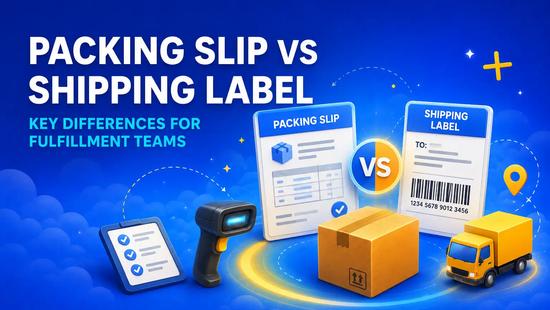
The confusion usually starts because both documents are tied to the same order. A packing slip and a shipping label may be printed during the same workflow, but they do completely different jobs. One helps the warehouse verify what belongs in the box. The other helps the carrier route the package to the right destination. When those roles are clear, picking, packing, shipping, and support all get easier.
What Is a Packing Slip?
A packing slip is the document inside the package that lists the contents of the shipment. A packing slip is used by the fulfillment team during packing and by the recipient after delivery to confirm the. It usually includes item names, quantities, SKU references, order numbers, and the shipping recipient’s information. In many operations, it may also include notes tied to substitutions, backorders, bundle contents, or internal references. A packing list is generally used to describe the contents of the shipment and does not include pricing or declared value.
That function makes the packing slip a warehouse tool first and a customer-reference document second. It helps the packer verify that the correct items are in the carton. It helps the receiving customer compare the delivered contents against the order. It can also help with returns, exchanges, and internal issue review when an order arrives incomplete or incorrect.
The packing slip is not the document that moves the box through the carrier network. It does not replace a label, nor does it tell the carrier how to route the package. Its role is tied to the order contents, not the transportation path.
Shipping Label Meaning in Fulfillment Operations
Shipping label meaning is straightforward in a fulfillment setting. A shipping label is the carrier-facing document attached to the outside of the package. It contains the delivery address, return address, service details, tracking barcode, and the shipment data needed to move the parcel through the carrier network.
In practical terms, the shipping label is what the carrier uses to route, scan, and deliver the package. If the label is wrong, damaged, or hard to scan, the shipment can be delayed, misrouted, or returned. That is why label quality matters so much in ecommerce fulfillment. The barcode, address block, and placement on the package all affect how smoothly the shipment moves.
A shipping label is not there to explain what is inside the box. Its job is transportation. It tells the carrier where the package is going and how it should move through the network.
Packing Slip vs. Shipping Label: The Core Difference
The clearest way to explain the packing slip vs. the shipping label is to look at the role each document plays during fulfillment.
A packing slip helps confirm the contents of the order. It supports packing accuracy, gives the warehouse a final content check, and gives the recipient a simple reference for what should be inside the package. A shipping label serves a different purpose. It supports transportation, scanning, routing, and final delivery.
Placement reflects that difference. A packing slip usually goes inside the package. A shipping label belongs on the outside, where it can be scanned quickly throughout the shipment journey.
The two documents answer different questions. The packing slip answers, “What belongs in this order?” The shipping label answers, “Where is this package going?”
What Information Belongs on Each Document?
A strong fulfillment workflow becomes easier to maintain when teams know what belongs on each document and what does not.
A packing slip usually includes:
- order number
- item names
- quantities
- SKU or internal product references
- recipient information
- warehouse or merchant notes when needed
A shipping label usually includes:
- recipient address
- return address
- tracking barcode
- tracking number
- carrier service details
- routing information tied to the shipment
The gap between those fields matters. A packing slip is content-focused. A shipping label is movement-focused.
When teams blur those functions, accuracy usually slips. A packer may assume the label confirms what is inside the box. A support team may assume the packing slip proves the package was shipped correctly. Neither assumption is strong enough on its own.
Why Fulfillment Teams Need Both
Some low-volume sellers are tempted to treat the packing slip as optional in some operations that can work for a while. Once order volume rises, product catalogs expand, bundles become more common, or returns start climbing, the lack of a packing slip often creates more friction than it saves.
The packing slip helps reduce packing errors. It gives warehouse staff a content checklist during the final packout. It gives the customer a reference point after opening the order. It also creates a clearer internal trail when a customer reports a missing item. The team can compare the order record, the packing workflow, and the shipment contents more easily when the package has a documented content list.
The shipping label is even less optional. Carriers need the label to accept, scan, route, and deliver the parcel. Each shipment must have its own label and tracking number. Shopify’s Managed Markets documentation states that each shipment must have a unique shipping label and tracking number, and using one label for multiple packages strapped together is prohibited.
For fulfillment teams, the best setup is not choosing between the two. It is using each one correctly.
Where Mistakes Usually Happen
One common mistake is treating the shipping label like proof that the order was packed correctly. A package can have the right label on the outside and still contain the wrong items inside. If the final pack check is weak, the shipment can move through the network with no problem until the customer opens the box.
Another issue is leaving out the packing slip on more complex orders. That becomes more noticeable with bundles, multi-item shipments, subscription orders, and partial fulfillments. Without a packing slip, customers have less clarity, and support teams have less to work with when something looks wrong.
Label placement also causes avoidable trouble. If a label is applied over a seam, corner, wrinkle, or heavy tape, scanning can slow down or fail. A clean, visible label helps protect tracking quality and keeps the parcel moving through the network with fewer interruptions.
How Packing Slips Help Returns and Customer Service
A packing slip can play a quiet but important role after delivery. When a customer opens the box, the packing slip gives them a simple way to compare what arrived against what they expected. That matters when the order contains similar items, multiple quantities, or bundle components.
It also helps with returns. A customer may not remember the exact SKU or product name from the original order. The packing slip gives them a clearer reference point. Internally, support teams can use the same document structure to review what the order was supposed to include and how it was packed.
This becomes especially useful for stores with broad catalogs, replacement parts, apparel variations, or products that look similar at a glance. The better the internal and customer-facing order record, the easier it is to handle the issue cleanly.
How Shipping Labels Affect Speed and Tracking
A shipping label does more than show the destination. It connects the parcel to scan events, tracking history, routing logic, and service-level movement. That makes label quality part of shipping speed, not a separate admin detail.
If the label is wrong, the shipment may be delayed before the customer even knows there is a problem. If the barcode is unclear, tracking visibility can suffer. If the address is incomplete, the package may need correction, rerouting, or return handling.
For fulfillment teams, this is simple. A clean shipping label helps the package move faster and helps the tracking record stay more reliable.
A Better Workflow for Ecommerce Teams
The cleanest workflow is simple. Pick the order, verify the contents, print the packing slip, complete the pack check, seal the box, and apply the shipping label correctly. That sequence creates two layers of control. The packing slip confirms the contents. The shipping label confirms the transportation details.
This is especially important when warehouses use multiple stations, several packers, or mixed shipment types. The more volume moves through the floor, the more valuable document clarity becomes. A fulfillment team does not need more paperwork for its own sake. It needs the right document at the right step.
That is where the difference between a packing slip and a shipping label stops being a technical definition and becomes a practical control point.
Summary
The difference between a packing slip and a shipping label is simple once the role of each document is clear. A packing slip helps confirm what is inside the package. A shipping label helps move the package through the carrier network.
For ecommerce fulfillment teams, both documents support accuracy, but they solve different problems. One protects the order contents. The other protects the shipment path. Using both correctly helps reduce packing mistakes, improve tracking quality, and make post-delivery issues easier to resolve.