How Dimensional Weight Affects Ecommerce Shipping Costs
Shipping Costs & Rates
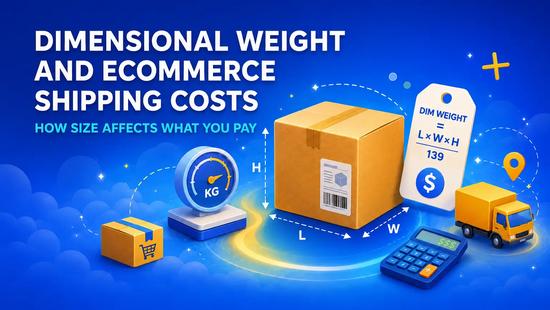
Dimensional weight has a direct effect on parcel cost control. Carriers do not price every shipment by scale weight alone. They also evaluate how much space a package occupies in their network. When a carton is large relative to its actual weight, the billed amount can rise well above what many merchants expect from the product alone.
This matters across a wide range of ecommerce categories, especially for brands shipping low-density products, bundled orders, protective packaging, and boxes with excess empty space. In these cases, shipping cost is driven by package dimensions as much as by product weight. Teams that do not monitor this closely often see avoidable margin loss, weaker checkout accuracy, and more invoice variance over time.
What Is Dimensional Weight
The answer is straightforward: it is a carrier pricing method that converts package size into a weight value. That value is then compared with the actual scale weight of the parcel. The higher figure becomes the billed weight for rating purposes.
Dimensional Weight Explained
Since parcel networks have limited vehicle and trailer space. A lightweight box that takes up significant cubic space can be less efficient for the carrier than a smaller, denser package. Dimensional pricing accounts for that difference.
Dimensional weight shipping affects many ecommerce businesses, even when the products themselves are not heavy. That billing method changes how ecommerce teams should think about packaging. A low-density shipment can become expensive quickly. A compact, dense shipment usually prices more cleanly. The product itself may be light, yet the carton profile can move the shipment into a much higher billed tier.
Why Dimensional Weight Increases Shipping Costs
The cost impact shows up when package volume rises faster than product weight. A shipment may weigh only a few pounds, but if the carton is large, the carrier may bill it at a much higher weight. That difference can change the economics of an order very quickly.
In ecommerce, this usually happens for three reasons. The first is oversized packaging. The second is excess empty space created by void fill or loose packing. The third is poor package setup in the shipping workflow, where the box assigned to the order does not reflect the actual packed shipment.
Once those issues appear across a large number of orders, shipping spend becomes harder to control. Quoted rates drift away from billed charges, checkout pricing becomes less reliable, and margin starts eroding on shipments that looked inexpensive at first glance.
Billable Weight vs Actual Weight
Actual weight is the full physical weight of the packed shipment. That includes the product, the box, tape, inserts, dunnage, and any protective material.
Billable weight is the number the carrier uses to price the parcel. If the dimensional result is higher than the actual scale weight, the shipment may bill at the dimensional figure instead. If the actual packed weight is higher, the carrier usually charges by actual weight.
That difference can be substantial. A six-pound order packed in a large carton may rate like a much heavier shipment once the box dimensions are applied. The same six-pound order in a tighter carton may still bill close to the scale reading. From a cost-control perspective, the scale does not tell the whole story.
Merchants often focus on product weight because it is easy to track. Billable weight deserves the same attention. Once those two numbers drift apart, shipping cost becomes harder to forecast and harder to explain.
How to Calculate Dimensional Weight
If your team wants to know how to calculate dimensional weight, the basic formula is straightforward:
Length × Width × Height ÷ carrier divisor = dimensional weight
The arithmetic is simple. The operational challenge comes from using the right inputs.
Measure the packed carton, not the loose product. Use the outer dimensions of the actual package that will move through the carrier network. Record length, width, and height carefully, then apply the divisor used by the carrier or service being quoted.
A common parcel example uses this structure:
18 × 14 × 10 = 2,520 cubic inches 2,520 ÷ divisor = dimensional weight
If the divisor is 139, the dimensional result is a little over 18 pounds. If the actual packed weight is 6 pounds, the shipment may be priced closer to 18 pounds than to 6 pounds. That is a major shift in shipping cost created by box volume alone.
Three common mistakes distort the calculation:
- Measuring the product instead of the packed carton
- Using stale package dimensions after a packaging change
- Assigning a default box that is much larger than the order needs
A reliable process starts with accurately packed dimensions in the shipping workflow. Without that data, the rate shown at checkout or in the label flow may not line up with the final billed result.
Where Ecommerce Brands Lose Money on Dimensional Weight
The most common source of avoidable dim charges is the oversized default carton. Many teams simplify fulfillment by using a small group of familiar box sizes. That can improve speed. It can also raise shipping costs across hundreds of orders when those cartons leave too much empty space.
The second source is over-packing. Fragile items need protection, yet excessive void fill can add inches in every direction. A minor increase in carton size may move the parcel into a higher-billed tier even when the product weight remains the same.
The third source is incomplete shipment data. If the order record includes product weight but not the real packed dimensions, the quoted rate can look clean while the final invoice tells a different story. That gap creates margin leakage and weaker pricing control.
The fourth source is the catalog mix. Stores selling low-density products usually see dim exposure earlier than stores shipping dense hardware or compact replenishment items. Decorative pieces, kits, bundled sets, apparel, pillows, lightweight accessories, and home goods often trigger dimensional billing faster than merchants expect.
The fifth source is a weak carrier comparison. One service may price a specific carton profile more aggressively than another. Running every parcel through the same default lane leaves money on the table, especially for dim-sensitive orders.
The Packaging Decisions Behind Higher Billed Weight
Dimensional charges often trace back to packaging choices that looked harmless at the time.
A broad assortment of boxes is one example. Too few box sizes force the team to use larger cartons for convenience. That speeds up packing in the moment and raises the billed weight later.
Bundle design is another. Gift sets, subscription shipments, and multi-item orders often create low-density packouts. The result is a larger carton without a matching increase in product weight.
Protective packaging also plays a role. Foam, paper, air pillows, and inserts all serve a purpose. The issue arises when the packaging setup inflates the carton beyond what the product requires. Shipping cost then reflects the empty space as much as the merchandise.
A packaging audit usually reveals fast wins. Review the orders where billable weight runs far above the actual weight. Check the carton used, the amount of void fill, the packed dimensions, and the order composition. Those records usually show where the margin erosion starts.
How to Reduce Dimensional Weight Costs Without Slowing Fulfillment
Lower DIM costs do not require a complete warehouse rebuild. In most operations, a focused set of changes delivers results quickly.
Start with the box library. Add a few better-fitting carton sizes instead of relying on oversized defaults. Even a one-inch reduction in one dimension can change the billed tier on repeat orders.
Then review product-level packaging logic. Some SKUs need their own carton rule instead of falling into a catch-all package setting. Kits, fragile products, and bundled orders often deserve separate treatment.
Next, clean up the shipment data. Product dimensions are useful, yet packed dimensions are what affect the carrier charge. A shipping workflow built on inaccurate package data cannot produce reliable rates.
Then compare carriers from the actual shipment profile. That means using the real packed dimensions, the true shipment weight, and the destination before the label is created. In many cases, the best rate outcome comes from better routing, not from a packaging change alone.
Finally, review invoice adjustments as part of the monthly shipping audit. If the carrier repeatedly remeasures parcels and charges a higher billed weight, the warehouse process needs attention. The same issue often appears across many orders once it appears in one part of the catalog.
Why Multi-Carrier Parcel Shipping Improves Cost Control
Many dimensional-weight problems become easier to manage when the team can compare carriers before committing to a label. That is one reason multi-carrier parcel shipping creates a practical advantage for ecommerce brands with mixed catalog sizes.
Different carriers and services can produce different outcomes for the same order. Divisors, service rules, surcharges, and rate structures all influence the final charge. A box that prices poorly through one parcel service may look more reasonable through another.
At Shipduo, we approach this as a shipment-level decision. Accurate dimensions, order data, and carrier comparison should work together. That gives merchants a cleaner way to route dim-sensitive orders, protect margin, and improve price accuracy before the shipment leaves the warehouse.
The same principle applies at checkout. Rates shown to the customer should reflect the real package profile as closely as possible. If the package setup is loose, the customer may see one price while the final shipping cost tells a different story.
A Better Operating Routine for Dimensional Weight Shipping
Dimensional cost control works best when it becomes part of the regular shipping routine.
First, isolate the shipments where the billable weight is well above the actual weight. That report identifies the orders that cause the largest disconnect between perceived and actual cost.
Second, review the packaging assigned to those shipments. Look for oversized cartons, excessive fill, and kit designs that create unnecessary empty space.
Third, verify the packed dimensions in the system. Update any stale defaults or old packaging profiles that no longer reflect current fulfillment practice.
Fourth, compare carriers based on the actual packed shipment. Rate shopping works best when the underlying dimensions are accurate.
Fifth, keep a close eye on recurring invoice adjustments. Frequent remeasurement charges usually point to a process problem that can be fixed at the packaging or data level.
Strong shipping operations treat dimensional pricing as a controllable input, not an occasional surprise. That discipline produces better quotes, cleaner carrier selection, and more stable margin over time.
To Wrap Up
Dimensional weight changes the economics of parcel shipping in a very direct way. The physical product is only part of the pricing equation. Package volume, box fit, shipment density, and carrier rules all influence the billed amount.
Merchants that manage by scale weight alone usually miss a meaningful source of cost pressure. A better approach considers packed dimensions, billable weight, box selection, carrier comparisons, and invoice adjustments together. That process leads to more reliable shipping rates, stronger packaging decisions, and better control over ecommerce shipping costs.