Freight Class Explained for Ecommerce Teams
Freight & LTL Shipping
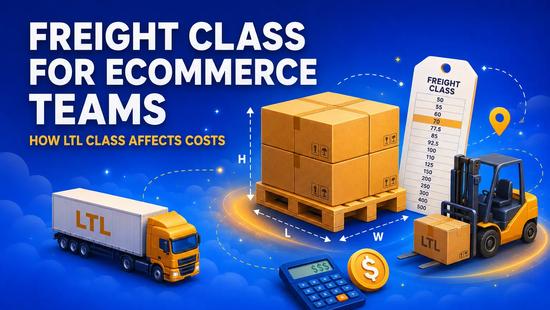
Freight class changes the cost, paperwork, and risk profile of an LTL(less-than-truckload) shipment long before pickup is scheduled. An incorrect class can distort the quote, trigger a billing correction, delay delivery, or create a claims issue after damage is reported. For ecommerce teams moving palletized orders, wholesale shipments, oversized products, or heavier outbound freight, LTL freight class is part of the job, not a side detail.
The confusion usually starts in the same place. Teams know the weight and destination, but the class still feels vague. That is where cost control starts to slip. A clean process for classing freight produces better quotes, cleaner bills of lading, fewer reweighs, and fewer unpleasant adjustments after delivery.
Freight Class Explained in Plain Terms
Freight class is the rating system used in U.S. less-than-truckload shipping to describe how difficult a product is to move through an LTL network. The class assigned to a shipment helps carriers price trailer space, dock handling, risk, and load planning consistently.
The class scale runs from 50 to 500. Lower classes usually apply to dense, durable freight that stacks well and moves with fewer complications. Higher classes tend to apply to shipments that are light for their size, fragile, hard to stow, or more exposed to theft and damage.
A useful distinction belongs here. Freight class and NMFC(National Motor Freight Classification) item numbers are connected, but they are not the same thing. The NMFC item identifies the commodity and its classification rules. The freight class is the rating assigned to a commodity based on how the product is described, packaged, and presented for shipment. In some cases, the class is fixed. In others, density and packaging influence the final class.
Why LTL Freight Class Has Such a Strong Effect on Cost
Carriers do not price palletized freight by weight alone. Two shipments can weigh the same amount and still create very different operational demands. One may be dense, stackable, and durable. The other may be bulky, fragile, or hard to load around. LTL class captures those differences and turns them into a rating structure.
That is why the LTL freight class has such a direct effect on price. A lower LTL class generally produces a lower rate. A higher class usually drives the rate up because the shipment occupies more space, creates greater handling difficulty, or introduces greater liability for the carrier.
The cost effect does not stop at the quote. Class affects billing accuracy after pickup as well. If the carrier inspects the freight and finds a mismatch between the bill of lading (BOL) and the physical shipment, the load may be reclassified. That can lead to a higher invoice, added fees, and extra administrative work for the shipping team.
The Four Factors Behind Freight Class
Freight class is built from four transportation characteristics: density, handling, stowability, and liability.
Density is the best-known factor because it has the clearest math. Dense freight takes up less trailer space for its weight, which usually supports a lower class. Low-density freight often moves the other way.
Handling covers the ease or difficulty of moving the freight through terminals and docks. Stable, well-packaged freight moves more cleanly than freight that is awkward, loose, fragile, or difficult to secure.
Stowability looks at how well the shipment fits with other freight. Pallets with odd dimensions, hazardous restrictions, or shapes that waste trailer space usually become harder to stow efficiently.
Liability reflects the chance that the freight may be damaged, stolen, or cause damage to nearby freight. High-value items, delicate goods, and products with unusual risk profiles often carry more liability concern.
Density often strongly influences freight class, especially for palletized shipments where size and weight do not align cleanly. The other three characteristics still matter. A shipment can have decent density and still rate higher if it creates stowability, handling, or liability problems.
How to Determine Freight Class Before You Quote
The answer to how to determine freight class starts with the commodity itself.
First, identify the product correctly. General descriptions create problems. “Parts,” “hardware,” or “equipment” are often too loose to support clean classification. The closer the commodity description is to the actual NMFC item, the better the result.
Second, confirm how the freight is packaged. Cartons on a pallet, crates, loose pieces, or shrink-wrapped bundles may not classify the same way. Packaging affects handling, density, and sometimes the rules attached to the NMFC item.
Third, measure the shipment accurately. Freight class depends heavily on correct length, width, height, pallet count, and total weight. Estimates are one of the fastest ways to create a bad class and an even worse invoice.
Fourth, calculate density in pounds per cubic foot. The standard formula is:
Weight in pounds ÷ cubic feet = pounds per cubic foot
To get cubic feet, multiply length × width × height in inches, then divide by 1,728. Once that density is known, check it against the commodity’s NMFC classification rules. Some items class directly by density. Others rely on a fixed class or a rule that still brings in handling, liability, or packaging conditions.
Fifth, place the correct class on the BOL and keep the shipment profile consistent from quote to pickup. A class is only as good as the data behind it.
Density Math Is Simple. The Operational Work Is Not.
Density is usually the easiest part of the process to calculate, yet one of the easiest to get wrong in practice.
A pallet that measures 48 × 40 × 48 inches has a volume of 53.3 cubic feet. If it weighs 800 pounds, the density is about 15 pounds per cubic foot. A pallet with the same footprint and only 300 pounds of product has a density closer to 5.6 pounds per cubic foot. Those two pallets may carry the same commodity family and still end up in different class positions if the applicable NMFC item uses density breaks.
Packaging decisions change that math fast. Taller stacks, wider pallets, loose cartons, or extra void space can push density down. Tighter pallet builds and better carton consolidation can push density up. A freight quote is often won or lost inside those few inches and a few cubic feet.
Ecommerce teams run into this often with bundled orders, mixed-SKU pallets, furniture-like products, lightweight manufactured goods, and wholesale shipments built for speed instead of density. The shipment leaves the warehouse looking fine. The rate tells a different story.
The Ecommerce Mistakes That Trigger Reclassifications
The first mistake is using a product category instead of a real commodity description. Freight class depends on the shipment presented to the carrier, not on a loose internal label from the catalog.
The second is guessing the class from memory. That can work for a narrow product line with stable packaging. It breaks down once new SKUs, seasonal assortments, or mixed pallets enter the flow.
The third is treating density as the only factor. Many items are now classified by density, but density alone does not override handling, stowability, and liability where the NMFC item still brings those characteristics into play.
The fourth is changing packaging without updating the freight record. A class based on last quarter’s pallet build may no longer fit the current one. Any change in dimensions, stack height, carton count, or protective packaging can shift the density and the class result.
The fifth is putting weak data on the BOL. A vague description, an estimated weight, or missing dimensions invite reweighing and reclassification. Once the carrier corrects the shipment record, the invoice usually follows.
A Cleaner Freight Process for Ecommerce Teams
Freight class works better when it is handled as part of a repeatable process instead of a last-minute quote field.
Keep a classing file for your common freight profiles. Include the exact commodity description, packaging method, typical pallet dimensions, weight ranges, and the class used most often. That saves time and reduces inconsistency.
Review mixed pallets carefully. A single pallet holding several SKUs can become harder to classify than a pallet with one product line. When the freight mix changes, the shipment profile changes with it.
Audit reclassifications monthly. If the same product family keeps getting corrected after pickup, the root cause usually shows up in the data, packaging, or commodity description.
Run quotes from accurate shipment details. A strong freight shipping platform makes this easier by tying together dimensions, weights, rate comparisons, BOL prep, and tracking into one freight workflow. That is one reason many ecommerce teams move away from spreadsheet-based classing and manual quote requests.
Final Take
Freight class is one of the most important rating inputs in LTL shipping, and one of the easiest to mishandle when the workflow is rushed. The cost effect is obvious, yet the larger issue is operational. A weak classing process creates quote errors, invoice disputes, reclass charges, and avoidable delays.
The stronger approach is simple. Identify the commodity accurately. Confirm the packaging method. Measure the shipment correctly. Calculate density. Check the NMFC rules. Put the right class on the BOL. Then keep the shipment profile consistent through pickup.
That discipline produces cleaner freight quotes and fewer surprises for the teams responsible for margin, fulfillment, and customer delivery performance.