Address Validation Mistakes That Create Delivery Failures
Delivery Accuracy & Tracking
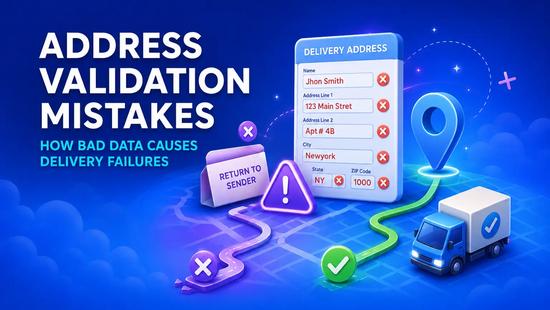
Address quality affects far more than the final mile. It influences service eligibility, carrier pricing, label accuracy, delivery speed, and the amount of internal rework created after an order ships. An address that appears acceptable to a customer or support agent can still fail against recognized delivery records, create a service conflict, or trigger a correction after the parcel is already in transit. Those failures usually appear later as delayed delivery, rerouting, return activity, added fees, or support escalation.
For ecommerce teams, poor address data is an operations issue before it becomes a customer-service issue. A bad address can result in a failed first attempt, a manual carrier intervention, a replacement shipment, or an invoice adjustment that was not included in the original rate. When that pattern repeats, the business starts paying for preventable data problems across fulfillment, support, and finance simultaneously.
Address Validation for eCommerce Begins Before the Label
Address validation for eCommerce is most effective when it starts at checkout and continues through order review and label creation. Online stores that validate early reduce the odds of releasing an order with incomplete or mismatched destination data. Shopify’s order tools validate addresses when online orders are placed and again during label creation, reflecting a practical shipping rule: the cheapest correction occurs before the parcel is packed and rated.
Field structure plays a large role here. Separate fields for street address, apartment or suite, city, state, postal code, and country create cleaner data than one loose address block. Standardized fields make it easier to detect missing unit information, mismatched localities, and invalid postal combinations. Address-quality systems used in carrier and postal workflows rely on standardized input because a destination must match a known delivery record, not simply look reasonable to a person reading the order.
A second checkpoint belongs in the order processing stage. Saved customer addresses, imported marketplace orders, copied addresses from email threads, and manual edits after checkout can all introduce problems after the customer has already paid. If the team assumes an address is safe because it came from a repeat buyer or from another system, weak data can still pass into fulfillment unchanged. A clean order flow keeps validation status visible until the shipment is ready for release.
Failed Deliveries in eCommerce Often Start With Missing Secondary Address Data
Apartment, suite, unit, room, and floor information is one of the most common failure points in ecommerce shipping. Multi-unit buildings frequently require this second layer of destination data to complete delivery. Without it, the street address may be correct, and the parcel may still be difficult or impossible to hand off to the right recipient. Postal addressing standards treat secondary unit designators as required when the destination uses them, which is why a missing apartment number can result in a delivery exception even when the rest of the address appears complete.
This problem becomes more expensive when the checkout form treats the second line as optional in a way that encourages customers to skip it. Mobile checkout makes that risk worse because customers often rush through address entry, rely on autofill, or assume the building is identifiable without the unit number. The result is a shipment that moves into the network with insufficient destination detail.
Postal-Code and Locality Mismatches Create Delivery Exceptions
A mismatched city, state, and postal code combination is another common source of delivery failure. The address may still look close enough to pass a quick human review, though carrier and postal systems process it differently. Standardization and delivery-point matching exist to resolve exactly this kind of problem because a small mismatch in postal data can affect routing, validation confidence, and the final deliverability of the parcel.
These mismatches often enter the order through autofill, customer memory, copied addresses, or outdated address-book records. If the order is released without a validation step, the issue may only surface after the parcel reaches the destination region, and local processing cannot reconcile the address cleanly. That creates a delay even when the package physically reaches the right broad geography.
Free-Form Address Lines Cause More Problems Than Teams Expect
Street lines become unreliable when customers load too much information into one field or spread key details across the wrong fields. Directionals, road types, building names, internal mail codes, and unit identifiers can all be entered inconsistently. Some orders remain recoverable, though the chance of carrier-side correction rises when formatting is weak and important details are buried in free text. Postal address systems are designed to work from structured data for that reason.
A structured form reduces this risk. It also speeds up manual review because the shipping team can immediately see whether the problem is a missing unit number, an invalid postal code, or an overloaded street line. Without that structure, the team spends more time interpreting the customer’s intent and less time fixing the order.
Service Conflicts Start With the Wrong Address Type
Some destination types conflict with specific carrier services. Post office boxes are the clearest example. If the store allows a post office box address and then routes the order toward a service that cannot deliver to it, the parcel enters the workflow with a built-in failure point. Label-creation tools surface this issue, though the operational cost is lower when the service conflict is blocked earlier in checkout or order review.
Military and diplomatic destinations also require precise formatting. These addresses do not follow the same pattern as a standard residential stop, and a label that treats them as ordinary domestic street addresses can fail even when all fields are filled. Address review should therefore consider destination type, not only spelling and completeness.
Residential versus commercial classification introduces another problem. Carriers may apply different charges based on address type, and an incorrect classification can trigger an invoice correction after shipment. UPS specifically warns shippers to select the correct residential status and notes that its systems support residential or commercial classification for established addresses. A wrong classification may not stop the parcel, though it can still change the cost profile of the shipment after the fact.
Address Correction Charges Rarely Arrive Alone
Address correction charges appear after the carrier has already spent time fixing the shipment record, rerouting the parcel, or adjusting the destination classification. The fee itself is only part of the cost. A corrected address can also trigger a late delivery, a support contact, a reshipment, or a refund conversation that would not have occurred with stronger address controls upfront.
For many stores, address correction charges stay buried inside broad shipping spend and never receive enough attention. That makes the underlying issue harder to spot. If the business does not isolate these charges, weak address data can keep inflating shipping cost while the team focuses on headline carrier rates instead of the data problems that changed the invoice later. USPS address-correction tools exist because missing or inaccurate address elements lead to manual handling and undeliverable volumes in real shipping operations.
Checkout Design Has a Direct Effect on Deliverability
A weak checkout form increases the chance of bad address data long before the warehouse touches the order. If apartment and suite prompts are easy to miss, if the postal code is not checked closely enough, or if the customer can continue with a poorly structured address, the store has already accepted a higher level of delivery risk. The problem is not limited to customer typos. Form design influences how often customers enter good data in the first place.
Autocomplete can improve speed, though it should not replace validation. Customers still choose the wrong match, skip the unit number, or rely on a saved address that no longer reflects the real delivery point. A better checkout experience combines suggestions with validation and clear prompts for missing information, especially for customers in apartment-heavy regions or business districts.
A Better Workflow for Address Validation for eCommerce
A stronger workflow starts with structured fields and continues with automated checks before fulfillment. Orders with incomplete unit data, suspicious postal combinations, destination-type conflicts, or address edits made after checkout should be held briefly for review rather than released immediately. That review should be narrow and rule-based so it catches preventable failures without slowing every order.
Service logic needs to be part of that workflow. Post office boxes should be routed to services that can deliver to them. Residential and commercial classification should be checked before the label is purchased. Military and diplomatic destinations should follow their proper format from the start. A shipping process that separates address review from service selection leaves room for avoidable exceptions.
Automation is most useful when it is tied to cleaner input data. A flow that includes USPS shipping label automation reduces repetitive entry and keeps rates, labels, and tracking close to the order record. Shipduo’s USPS integration is designed around live rates, label generation, and delivery tracking, all from one dashboard, making it easier to maintain consistency once the destination data has passed validation.
What Ecommerce Teams Should Measure Each Month
Address quality improves faster when it is tracked as its own operating category. Start with orders flagged during validation, then separate manual address edits, carrier-side corrections, returns to sender, reroutes, and support tickets tied to destination issues. Each of those metrics points to a different weakness in the workflow.
Carrier-side correction charges deserve their own reporting line. The same applies to orders that required customer outreach before release and to shipments that failed on the first attempt because the delivery point could not be completed. A monthly review should also isolate repeat patterns by destination type, order source, and customer segment. Saved addresses, apartment-heavy regions, imported orders, and post-purchase address edits often reveal the most useful patterns.
Let’s Conclude
Most address-related delivery failures are preventable. The shipping team does not need perfect data for every order, but it does need a process that catches incomplete, mismatched, or service-conflicting addresses before the parcel enters the carrier network. Early validation, clearer checkout fields, stronger service rules, and focused order review reduce failed deliveries in eCommerce more effectively than chasing corrections after the label is printed.